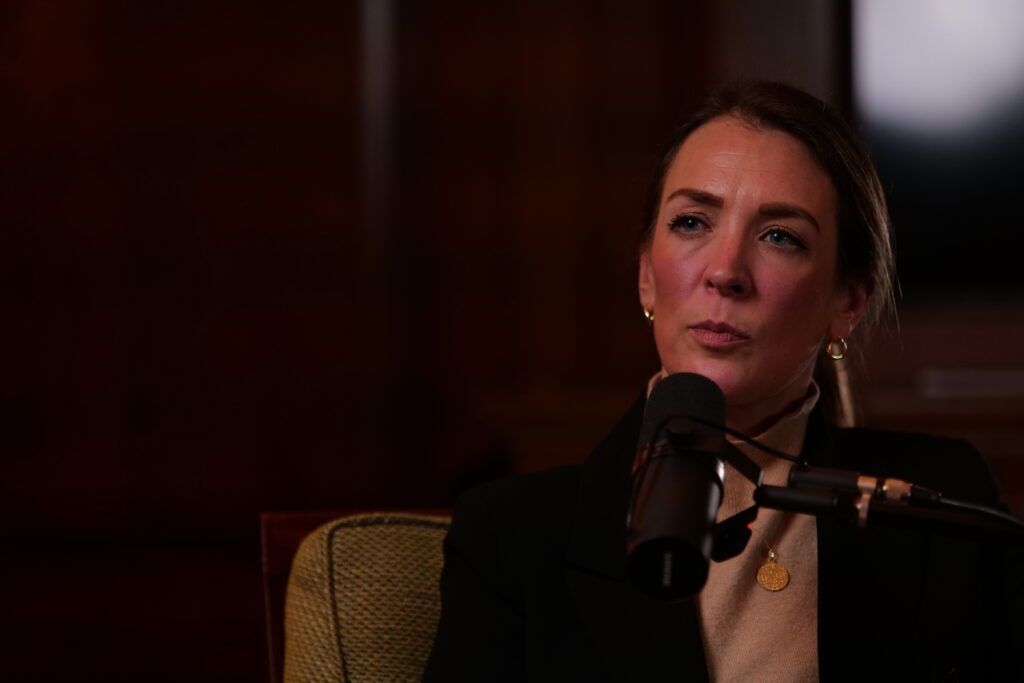
A conversation with Laura Fordham on the tough early years, the referrals that actually work, and why she thinks more women should be doing this job.

I sat down with Laura Fordham, an employed financial adviser at Titan Wealth, to talk about the years nobody really talks about, the ones before a career in financial planning looks anything like a success story. Laura’s route into the profession started in an admin job at Barclays Wealth, took her through the St. James’s Place Academy, and eventually into independence and an acquisition into Titan Wealth. Along the way she built a genuinely loyal client base almost entirely from scratch, using an approach to referrals and inherited clients that’s worth hearing in her own words.

What Does “Eat What You Kill” Actually Mean in Financial Planning?
Laura didn’t hesitate when I asked her to describe her first year at St. James’s Place. She’d started with somewhere between ten and twenty clients and was handling every part of the job herself, the planning, the admin, the chasing, the client servicing, and the advice, with no illusion that any of it would be easy.
“It’s amazing how what sort of drive that is to actually write business and to actually onboard clients. And it really gives you the mindset that this is tough. Nobody, nobody was under any illusion, and myself either, that this was going to be easy.”
That phrase, “eat what you kill,” gets used a lot in this industry, usually to describe pressure. Laura used it to describe something closer to fuel. The tough early years weren’t a warning sign for her, they were the thing that forced her to actually go out and build something, one small win at a time, until those wins started adding up into a real business. Those wins didn’t need to be big to matter. Landing a client she could hardly believe she’d won was often enough to carry her through another few weeks of the grind, long before any of it felt like a proper business.
How Do You Build Professional Connections Without a Hard Sell?
Once Laura had a foundation of clients, the next challenge was growing beyond word of mouth alone, and that meant building relationships with accountants and solicitors who could refer clients her way. She was candid that the advice which shaped her approach here didn’t come from a training manual. It came from a personal contact who told her, simply, that nobody likes being sold to.

“No one wants to commit to any long term sort of contract saying you must refer X amount to me. But just saying, I’d really like to work together. If you feel that there’s a client that would fit my general demographic, or you think personality wise it would be right for the client, please give me the opportunity to speak to the client.”
What stood out to me here was how low-pressure the entire approach is. No quotas, no contracts, nothing that would make a professional contact feel cornered into referring business. Just an open ask, and a genuine offer to send business back the other way too, because as Laura put it, it has to be mutually beneficial or it doesn’t work at all.
What Happens When Clients Inherit an Adviser They Didn’t Choose?
Not every client Laura looks after today chose her. Through Titan Wealth’s ongoing acquisitions, she regularly inherits clients who were previously looked after by someone else entirely, sometimes someone with a completely different working style. She told me she takes that seriously, and it shows in exactly how she approaches those first meetings.
“I really want to make a great first impression. And I want to understand what they loved about their previous advisor, and maybe not what they didn’t like. But was there anything missing, is there anything else that we can offer you? Was there any sort of gaps in any areas of the service that we gave you?”
It’s a simple set of questions, but it reframes the entire first meeting. Instead of introducing herself and her own process, Laura starts by trying to understand what already worked, and what didn’t quite land, before she changes anything at all. It’s a small act of humility that clearly pays off. She told me that kind of focus and dedication in those early months is what actually keeps a client long term, not a flashy pitch, just consistent attention.
Why Are Only 16% of Financial Planners Women?
Toward the end of our conversation, Laura and I talked about a statistic that’s hard to ignore: only around 16% of financial planners in the UK are women. Laura’s own client bank, 110 households with an average portfolio of £750,000, was built through exactly the approach she’d just described to me, patient, relationship-first, low-pressure work that rewards people who are genuinely curious about other people’s lives. That, she argued, is precisely why more women should be looking at this career seriously. It’s a profession built for people who want to keep learning, who want long-term relationships rather than one-off transactions, and who are comfortable being kept on their toes. It rewards the kind of people who want to explore their own strengths and weaknesses on the job, not just apply a fixed skill set on repeat. None of that requires a background in finance to recognise. It just requires someone willing to notice it, the way Laura did, while she was still printing out someone else’s client packs.
Laura’s story is a useful reminder that a strong client bank isn’t usually built through one clever strategy. It’s built through years of doing the unglamorous work properly, showing up for professional contacts without pressuring them, and giving every new client, chosen or inherited, the same level of attention. If you’re building your own client base from the ground up, or thinking seriously about a career in financial planning, this is a conversation worth your time.
🎧 Listen to the full episode with Laura Fordham
🌐 Learn more about Titan Wealth at www.titanwealth.com
Financial Planner Life is sponsored by Redmill Advance – Adviser CPD & Exam Support.
Whether you’re starting out, already qualified, or building a training academy, Redmill Advance delivers expert-led learning, exam support and CPD from Level 4 to Chartered.
Trusted by top UK firms
Learn more about Redmill Advance here.